
The Cut Worm

It is the way of all things,
I can appreciate that now.
Someday, without realizing it,
someone will write their last poem.

And it won’t be merely their
last poem, but the last poem—
a final verse from a cursed humanity
with no one left alive to read it.

A few rhymes scrawled across some papers
in the shaky light hand of a retching youth.
A choked voice rising from pungent vapors
with no one left alive to speak the truth.

          I wonder when, and I wonder how;
          what will their sonnet be about?

The flash? The light? The unbearable cold?
Mushroom cloud? Hurricane? Fire? Cyclone?
The heat? The stifling? The dread desolation?
The silencing stillness of a dead civilization?

Or will those last stanzas be composed of hope,
noting life will go on wearing a different cloak?
Or in appreciation of a gardenia’s white folds?
Or the final pink sunset of yellows and golds?

The tall eastern pines that no longer stand?
Tsunami waves o’er the broken wasteland?
I must wonder when, and I must wonder how—
will the cut worm forever resent the plow?
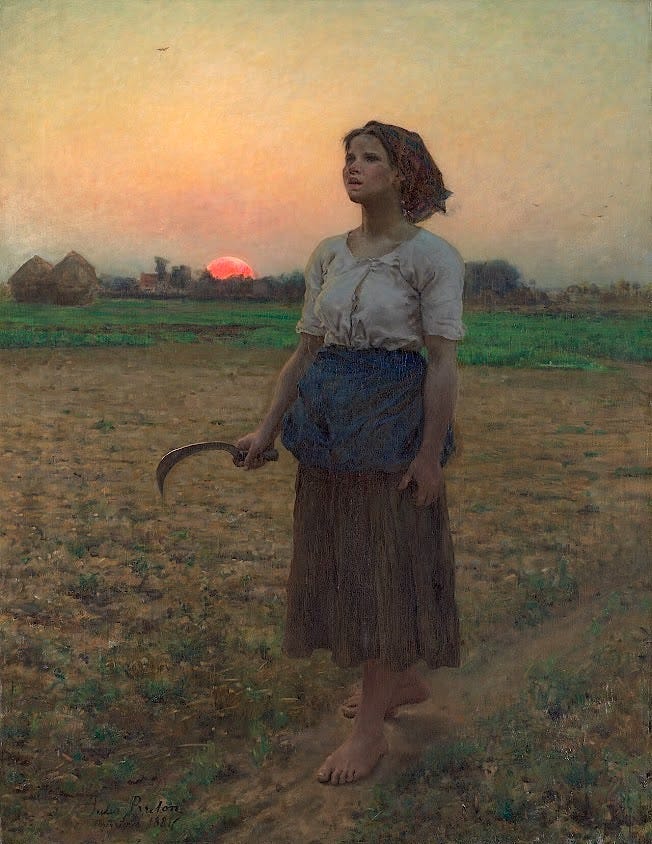
(Words ©2026 Henry Long. Image: Jules Breton (1827-1906), The Song of the Lark, 1884, Oil on canvas.)
For me, this poem feels almost biblical in its meditation on endings — like Ecclesiastes, where everything has its season, and Revelation, where the world trembles at the edge of judgment. The idea that someone might write not only their last poem, but the last poem, is haunting.
What stands out is the contrast between destruction and beauty: mushroom clouds, fire, storms, and silence set against gardenias, sunsets, and remembered trees. The final line — “will the cut worm forever resent the plow?” — feels like a proverb about suffering, fate, and the mystery of forces larger than ourselves.
Overall, it reads as a dark but thoughtful reflection on extinction, memory, and the last fragile voice of humanity.
This is amazing, Henry. A profound rumination on the last poem ever that took my breath away. I've been feeling this general zeitgeist myself, but to assuage my own fear, wrote "the pub at the end of all time" where the mother god is about to allow the world to be destroyed, but when she sees people living it up in their final days, changes her mind deciding there's something worth keeping in it. I personally lean into the idea we have a bit of free will and the world demands we use it for good, but that higher powers will see the seed of consciousness through any storm of our making or otherwise. In my (too sunny?) view, there will never be a last poem - though perhaps a last poem on earth and that alone is heart-wrenching.